Breakdown Recovery vs Roadside Assistance: What’s the Difference?
Breakdown Recovery or Roadside Assistance: Which Service Do You Need?
A flat battery outside your house, a warning light on the A34 and an engine failure on the M4 are very different situations. But they can all leave you asking the same question: do I need roadside assistance, or do I need breakdown recovery?
The difference is fairly simple.
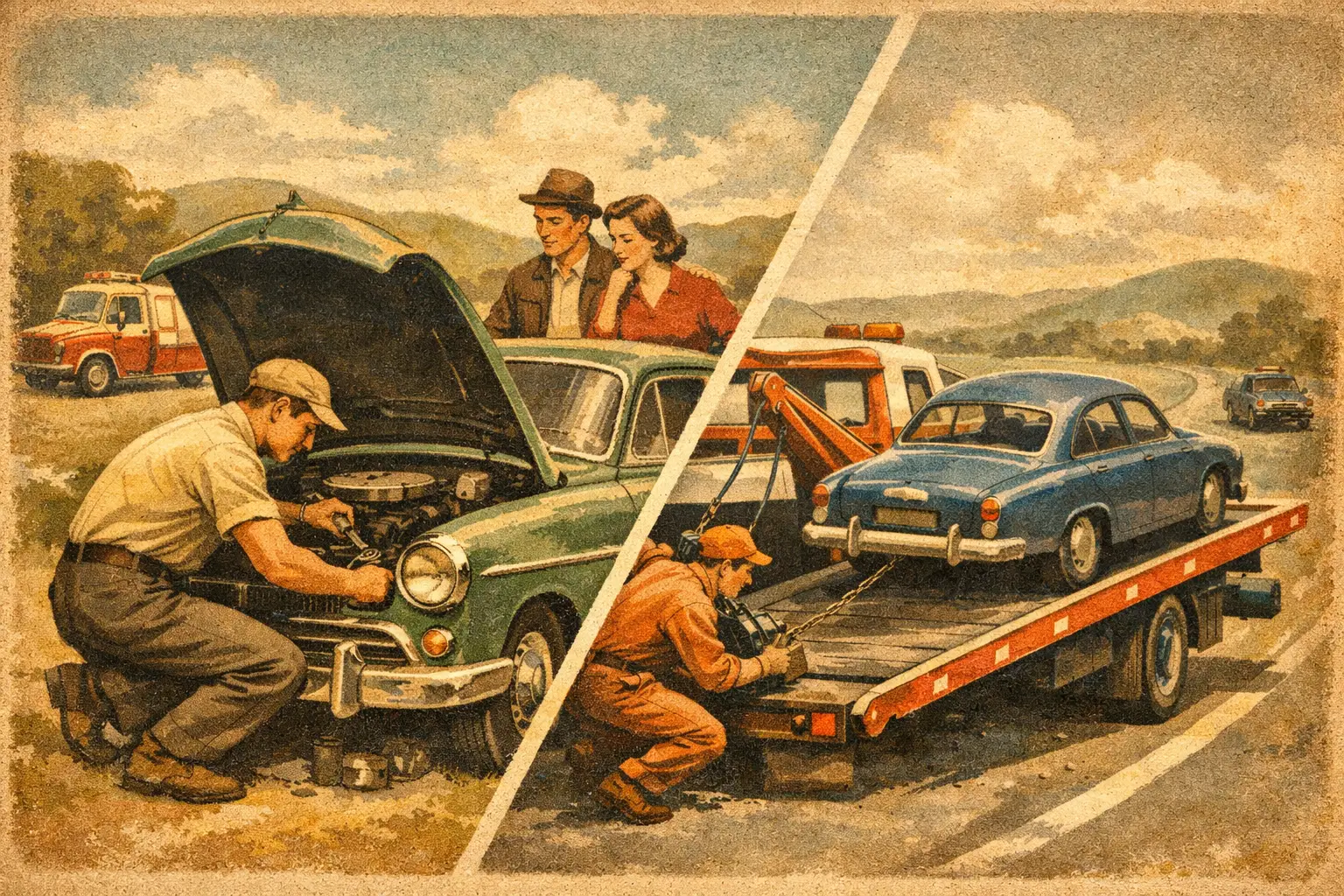
Roadside assistance aims to solve the problem where the vehicle has stopped and get you safely moving again.
Breakdown recovery is needed when the vehicle cannot be repaired safely at the roadside and needs to be transported to a garage, your home or another agreed destination.
The important part is knowing which option is appropriate for the condition of the vehicle. Sometimes a relatively simple roadside fix is all that's required. Other times, attempting to continue driving can make the problem worse or put you and other road users at risk.
What Is Roadside Assistance?
Roadside assistance is normally the first option when there is a realistic chance that the problem can be resolved safely where the vehicle has stopped.
The objective isn't to carry out a full workshop repair at the side of the road. It's to identify the immediate problem and, where practical, get the vehicle moving again safely.
Common situations can include:
- Flat or discharged batteries
- Jump starts
- Certain wheel and tyre problems
- Minor faults that can be dealt with safely at the roadside
- An initial assessment before deciding whether recovery is required
A flat battery is a good example. If the vehicle simply needs a jump start and there are no signs of another problem, roadside assistance may get you moving without requiring recovery.
But if the battery problem is actually being caused by a failed alternator or another electrical fault, getting the engine started may only be temporary. In that situation, recovery to a garage may be the more sensible option.
When Is Roadside Assistance Enough?
The key question is:
Can the problem be dealt with safely and can the vehicle then continue its journey reliably?
If the answer is yes, roadside assistance may be all you need.
A puncture, for example, may be relatively straightforward if there's a serviceable spare wheel, the necessary equipment is available and the vehicle is stopped somewhere safe.
The same problem on the hard shoulder of a busy motorway, with no suitable spare or additional wheel damage, is very different.
Location matters just as much as the fault itself.
Something that might be simple to deal with on a driveway could be unsafe to attempt next to fast-moving traffic. A professional operator should consider both the vehicle and the environment before deciding what happens next.
What Is Breakdown Recovery?
Breakdown recovery becomes necessary when the vehicle cannot safely, legally or reliably continue its journey.
Instead of trying to resolve the problem at the roadside, the vehicle is safely loaded and transported to an agreed destination.
That could be:
- Your home
- A local garage
- A main dealership
- A specialist repairer
- A business premises
- Another agreed location
Mechanical failure, serious overheating, steering or suspension problems, significant wheel damage and faults that require workshop diagnosis are all situations where recovery may be the appropriate option.
And sometimes the decision is straightforward: if continuing to drive risks causing considerably more damage, recovering the vehicle is usually the better choice.
Breakdown Recovery After an Accident
Recovery isn't limited to mechanical breakdowns.
After a collision, a vehicle can sometimes appear driveable while still having damage that makes continuing the journey unsafe.
Damage to steering, suspension, wheels or tyres may not always be immediately obvious. Loose bodywork, leaking fluids, damaged lights or deployed airbags can also mean the vehicle shouldn't continue on the road.
In those circumstances, the priority isn't getting the car moving again. It's getting the people involved somewhere safe and then moving the vehicle appropriately.
Accident recovery can take the vehicle to a garage, bodyshop, storage facility, home address or another destination depending on the circumstances.
Roadside Assistance vs Recovery: A Simple Example
Imagine your car won't start outside your home in Newbury.
If it's simply a discharged battery and a jump start gets the vehicle running normally again, roadside assistance has solved the problem.
Now imagine you're travelling on the A34 and the engine loses power, warning lights appear and the vehicle will no longer run properly.
Restarting it and hoping you can make it home isn't necessarily the right answer.
If the fault cannot be safely resolved there, breakdown recovery is the appropriate next step.
That's essentially the distinction:
Can we safely get the vehicle moving again?
If yes, roadside assistance may be enough.
If not, recover it rather than risk making the situation worse.
What Information Should You Give the Recovery Operator?
Whether you need roadside assistance or recovery, accurate information helps us understand what we're dealing with before arriving.
Try to provide:
- Your exact location
- Vehicle registration
- Make and model
- What happened before the vehicle stopped
- Any warning lights
- Visible damage
- Whether the vehicle starts
- Whether the wheels appear damaged or locked
- Number of passengers
- Your preferred destination if recovery is required
You don't need to diagnose the problem yourself.
Simply explain what happened and what you can see.
Our guide on how to get roadside assistance fast explains what information can help when you're arranging assistance.
If you're arranging the collection of a vehicle that already cannot be driven, such as an auction purchase, the requirements are different again. Our non-runner collection from Copart is a real example of this type of planned vehicle movement.
What If You Break Down on the M4 or A34?
If you stop on a motorway or high-speed road, your personal safety comes first.
Don't attempt a roadside repair where doing so would put you in danger from moving traffic. Get yourself and passengers to an appropriate safe position where possible and follow the relevant emergency guidance for the road and situation.
Once you're safe, roadside assistance or recovery can be arranged depending on what's happened to the vehicle.
J13 Rescue is based around Newbury, Berkshire, with convenient access to the M4, A34, Chieveley and surrounding West Berkshire road network.
That local position is particularly useful for breakdowns around the M4 Junction 13/A34 area, while longer-distance recovery and vehicle transport can also be arranged when the vehicle needs to travel further.
Does Breakdown Cover Include Both?
That depends entirely on the policy.
Some breakdown policies include roadside assistance but place restrictions on how far the vehicle can be recovered. Others may include home assistance, national recovery, onward travel or additional benefits.
Don't assume that having “breakdown cover” means every destination and every situation is included.
If you're already covered, check the terms of your policy.
If you don't have breakdown cover, that doesn't necessarily mean you're stuck. You can contact an independent recovery company directly and arrange roadside assistance or recovery as a one-off service.
What About Planned Vehicle Transport?
There's another distinction worth making.
Not every vehicle carried on a recovery truck has actually broken down at the roadside.
A non-runner purchased from an auction, a vehicle being transferred between locations or a car being moved to a specialist garage can be a planned vehicle transport job rather than an emergency breakdown recovery.
J13 Rescue supports both urgent roadside situations and planned vehicle movements, but they're different requirements and each job needs to be assessed accordingly.
For a planned collection, providing the collection address, destination, vehicle condition, key availability and any access restrictions beforehand helps everything run smoothly.
Which Service Do You Need?
You don't necessarily need to know before you call.
If you're unsure whether the problem needs roadside assistance or full recovery, explain what's happened.
A good recovery operator should be able to assess the information and determine the most practical response.
The objective shouldn't be to recover every vehicle unnecessarily. Equally, it shouldn't be to force a temporary roadside fix when the vehicle isn't safe or reliable enough to continue.
The right solution is the one that gets you and the vehicle safely to the next step.
Need Roadside Assistance or Breakdown Recovery in Newbury?
J13 Rescue provides 24/7 roadside assistance and vehicle recovery in Newbury, Berkshire and surrounding areas, including the M4 and A34 corridor.
Whether your vehicle needs a straightforward roadside response or needs to be recovered to a garage, home or another destination, we'll establish what has happened and arrange the appropriate response.
We also provide longer-distance vehicle transport and planned collections for private and trade customers across the UK.
Call J13 Rescue on 07897 467 319 for roadside assistance or vehicle recovery.
I'd publish this version. It has a particularly useful SEO characteristic: we're not trying to make “breakdown recovery vs roadside assistance” appear unnaturally twenty times. We're answering the question properly and using related terms naturally.
And compared with the previous fleet recovery account article, this is much more aligned with what someone could genuinely search right before needing your service, so it's considerably more valuable for the site at the moment.